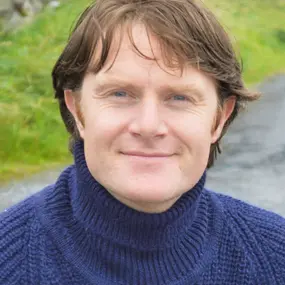
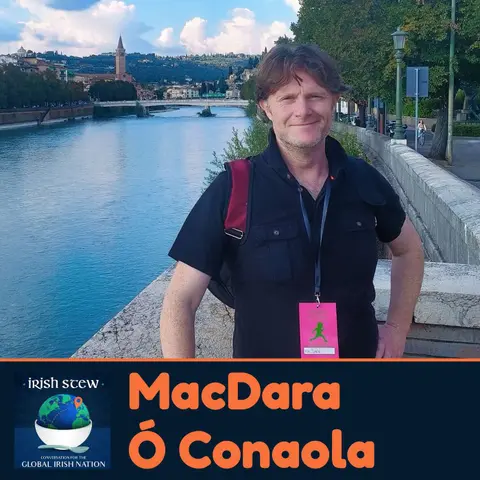
Back on the Aran Islands with MacDara Ó Conaola

 Apple Podcasts

 Spotify

 YouTube

 Overcast

 Podcast Addict

 iHeartRadio

 PocketCasts

 Amazon Music

 Castro

 Castbox

 Podchaser

 TuneIn

 Deezer

 Spreaker

 RSS Feed
Almost five years ago, sean-nós singer and native Irish speaker MacDara Ó Conaola gave Irish Stew a tour of Inis Oírr, the smallest of the Aran Islands. Since then he has moved to the mainland, worked two very different jobs, taken a slice of Irish culture to Italy, and come home again.
For our 170th episode, Martin catches up with MacDara back on the island, still as passionate about the language as ever. “I keep telling younger people, and just anybody really, that Irish can open a lot of doors,” he says, “and it’s a very positive thing.”
The conversation covers his year as an Irish language officer in Ennis, County Clare, and the story of Clare’s lost Gaeltacht, where the last native speaker died only in 1996. His work there launched Irish language events and projects that are still running.
While MacDara's role as a language officer was satisfying, he wanted to spend less time in the office and more time rubbing shoulders with people. So he moved on to Bunratty Castle and Folk Park, where he had his own cottage as the Irish language and sean-nós singing interpreter. He calls it “the nicest job I ever had.” There he got visitors from Alabama and Connecticut talking to each other, and met Jason Alexander and Jimmy Kimmel along the way.
When his time at Bunratty came to an end last winter, MacDara went looking for his next project, and found it in Verona, Italy. A cold email to Tocatì, a festival of street games that features a different guest country each year, led to Ireland taking the spotlight this September, with a delegation of about 200 sportspeople, musicians, craftspeople and Irish speakers from the Gaeltacht.
His advice for anyone learning Irish is hopeful: speak it at home, starting with the youngest. “They’re not judging you,” he says.
The episode features three of MacDara’s songs: Caisleán A’ tSléibhe; The Love Token, title track of his 2006 album; and Fadó Fadó, recorded with his children, Seán and Michelle.
LINKS
MACDARA Ó CONAOLA
- Original Irish Stew Episode (December 2021)
- Irish Vibes on TikTok
- Music on Spotify
- Fadó Fadó on Bandcamp
IRISH STEW LINKS
- Website Home Page
- BlueSky
- Mastodon
- Media Partner: IrishCentral
Episode Details: Season 8, Episode 29; Total Episode Count: 170
00:00 - Introduction
02:27 - Irish, Five Years On
08:03 - From the Island to Ennis
12:33 - Clare's Lost Gaeltacht
17:12 - Why He Left the Job
19:13 - Bridges at Bunratty
24:46 - Music Break: The Love Token
26:16 - Taking Ireland to Verona
30:48 - Home to Inis Oírr
33:52 - Speak It at Home
37:03 - The Seamus Plug
38:25 - Martin Recaps
41:38 - Credits
Back on the Aran Islands with MacDara Ó Conaola
Episode transcript · Released October 26, 2026
This transcript was generated by AI speech-to-text and given a light editorial pass to remove filler words, false starts and repeated words. Names, places and organizations were reviewed and confirmed by the Irish Stew production team. The episode itself is the authoritative record.
Speakers: Martin Nutty MacDara Ó Conaola
Jump to chapter
# TIME CHAPTER
1 0:00 Introduction
2 2:27 Irish, Five Years On
3 8:03 From the Island to Ennis
4 12:33 Clare's Lost Gaeltacht
5 17:12 Why He Left the Job
6 19:13 Bridges at Bunratty
7 24:46 Music Break: The Love Token
8 26:16 Taking Ireland to Verona
9 30:48 Home to Inis Oírr
10 33:52 Speak It at Home
11 37:03 The Seamus Plug
12 38:25 Martin Recaps
13 41:38 Credits
0:00 Introduction
[0:00] Music: Caisleán A' tSléibhe, sung by MacDara Ó Conaola
Martin Nutty [0:25]
That's MacDara Ó Conaola singing Caisleán A' tSléibhe. Almost five years ago, he joined us from Inis Oírr, the smallest of the Aran Islands, which lie off the west coast of Ireland facing into the Atlantic. Next stop, America. Not long after that episode, he moved to the mainland. Now he's back home. Welcome to Irish Stew, the podcast for the Global Irish Nation. I'm Martin Nutty, flying solo today.
Martin Nutty [1:01]
Before we begin, a quick ask. Our free weekly newsletter brings you each new episode and the story behind it, so if you want a closer look at what we do, you can find the sign-up on our home page at IrishStewPodcast.com. And one more thing. In December, we're hosting four of our listeners on the show. At the end of this episode, I'll tell you how you can be one of them.
This is our 170th episode, and one of the pleasures of a show that has run this long is the chance to catch up with former guests from years ago and find out what happened next in their lives. MacDara, as some of you might remember, is a sean-nós singer and a native Irish speaker. In his first episode, he gave us a tour of Inis Oírr and told us the magic starts when the last boat leaves. He's been busy since that episode. There was an Irish language job in County Clare and a cottage at Bunratty Folk Park full of visitors from around the world. Then he took the Gaeltacht to Verona, Italy. He's as passionate as ever about the Irish language, and we'll hear more of his music along the way. And so now, here's MacDara Ó Conaola.
2:27 Irish, Five Years On
Martin Nutty [2:27]
MacDara Ó Conaola, tá fáilte romhat go dtí an podchraoladh arís. [MacDara Ó Conaola, welcome back to the podcast.]
MacDara Ó Conaola [2:45]
Go raibh míle maith agat, a Mháirtín. Tá mé sásta a bheith ar ais. [Thank you very much, Martin. I'm happy to be back.]
Martin Nutty [2:52]
What was interesting was your episode five years ago was the first one which had a fairly significant focus on the Irish language, on Gaeilge. What have you noticed about the Irish language, let's say, in the last five years since we've talked?
MacDara Ó Conaola [3:09]
You see, the thing about the Irish language is it's something very deep, and it's something very positive and negative at the same time, in Ireland, and then for people who leave Ireland, people who had great-grandparents, great-great-great-grandparents who spoke Irish, and then people who never heard of Irish or didn't realize that Ireland had its own language. Ireland is such a small country, but we have such reach in our culture, so people are interested in Irish anyway. The Irish language is a niche, and it's growing and growing and growing. And there's a whole country, Ireland, which, whether they liked it or not, had to learn it at school, and we know that it's been taught terribly for generations at this stage. People either love it or hate it or couldn't care less, and it can be a divisive thing.
Most people, even Irish people, not even Americans or people from other countries, don't realize that the Irish they learn, I'm doing the quotey things, that they learn at school is different than what a native speaker would speak. There's a lot of unawareness. So if somebody was looking for a podcast to do with the Irish language, and let's say they found my episode with you, maybe there weren't that many then. Now there's loads of podcasts talking about the Irish language and every kind of type of Irish, if you know what I mean. But I keep telling younger people, and just anybody really, that Irish can open a lot of doors, and it's a very positive thing.
Martin Nutty [4:56]
Yeah, I think the last time we talked, you had expressed a concern that younger people in the Gaeltacht really didn't value the language. It was, let's say, not a big plus in their life. It wasn't something to be cherished. Do you detect any sense of movement in that, that people are beginning to feel like, hey, the fact that I speak this language fluently is a virtuous thing now?
MacDara Ó Conaola [5:30]
No, it's still heading down a slippery slope, really, in the Gaeltacht. The Gaeltacht, for anybody listening, is an Irish-speaking area; they're tiny parts of Ireland where people still speak the language. But there's glimmers of hope. You'll hear something on the radio, on Raidió na Gaeltachta, or on TG4, the Irish language television channel, and you'll see, oh, kids, and they have very good quality Irish. Because what was also happening was, because they weren't speaking the Irish, it'd be hard to make out sometimes if they were from the Gaeltacht or not. So there's glimmers of hope, and there's teachers, people working in the community, trying to get things done through Irish.
But what I tell people is that the only thing that saved the Irish language, up until maybe 20 or 30 years ago, and people from outside the Gaeltacht didn't really understand this, were the grants. There was a grant, and long ago it was £10 per kid per year to speak Irish. So basically it was just, we'll pay you, you speak Irish, that's all you have to do. And then it rose in the '80s, when I was a kid, to 100. But if there's four in a family, 400 pounds a year, that's a nice chunk of money. But then they got rid of that, I think it was in the early '90s. And there's a clear-as-day parallel: from the moment they stopped those grants, a nosedive in kids speaking Irish. For the next while it held, because people were used to speaking Irish, but then inevitably English snuck in. It's so correlated, the dip, and it's not a dip, it's literally a nosedive of people speaking Irish.
Martin Nutty [7:16]
Was that to encourage Irish being spoken at home?
MacDara Ó Conaola [7:20]
Oh, yeah, yes.
Martin Nutty [7:21]
Those grants were given specifically to parents, and the message was, we are giving you this grant to encourage you to speak at home.
MacDara Ó Conaola [7:29]
Yeah, yeah, it was encouraging.
Martin Nutty [7:30]
In Irish, right? And so consequently, pulling the plug on that, I'm guessing, caused some resentment.
MacDara Ó Conaola [7:38]
Yeah, I never thought of that. Because a lot of families, I would say even 65% of the families, would have spoken Irish anyway. My family was like that. Most people on the island were like that, actually. But all you need is a small percentage. There's this big figure they talk about, I don't know if it's 65 or 75%, that if this amount of the population are speakers, then it's safe. And if it goes under that, then it's inevitable.
8:03 From the Island to Ennis
Martin Nutty [8:03]
So, I remember I asked you what you would hear if you opened the door and listened. So what would you hear today? Conas atá an aimsir inniu? How's the weather today?
MacDara Ó Conaola [8:17]
Tá an aimsir go deas. Go breá. Tá an ghrian ag taitneamh. [The weather is nice. Fine. The sun is shining.] And right now, you would hear they're working on the pier here on Inis Oírr. We had a nice pier for decades at this stage, but it wasn't big enough, because so many people want to come to the island now that we need a bigger pier for all the boats. But also in winter it's very dangerous, because a big swell comes there, so they have a breakwater there now. So that's what you would hear: the crane, and just working on the pier, and always a slight breeze, because we're an island after all. And the birds.
Martin Nutty [8:56]
So what's interesting, of course, and may not be obvious to listeners, and I recommend you listen to the original episode, I'll put a link in the show notes: in the interim of the five years, you left Inis Oírr, and now you're just back there as of June. And you fetched up in Clare, in Ennis, I believe. So tell us about the reason for that move. One of the things that I've really appreciated in the past years is the problem that uprooting can cause to people. And so you uprooted yourself out of Inis Oírr. So tell us about that move, what drove it, and some of your experiences.
MacDara Ó Conaola [9:38]
My wife, Anna, and I, before we had kids, we moved around, not a lot, but we spent seven years in Dublin, five, six years in Galway, a few years here and there on Inis Oírr. So Inis Oírr was always the base, and always will be a base to go back to and feel like home. And it's nice to have that security. And like I was saying when I was talking to you the last time on the podcast, talking about the Irish language, I felt like I needed to do something. At the time, a lot of new OPT officers, Irish language officer jobs, were coming up. And so I applied for the one in Ennis, because Ennis is not a huge town. It's about 30,000 people altogether. So I said, that would be a nice project to work on and to get the Irish language going there. So I applied for the job, and luckily I got it. And so we said, okay, let's move to Ennis. And we found a house there and everything, and it's a lovely town.
So I worked as an Irish language development officer: basically getting Irish out, getting businesses to use Irish, getting Irish events going. And that was a lot of fun. But also with a thing like that, there's the bureaucratic side. So I learned a lot about how the government works and how Irish language organizations work, how they don't work together. This is one of the taboos: that if they all worked together in the same direction, Irish would be in a much better state. And it's a constant uphill battle to get people interested. Most people in any town in Ireland, any county in Ireland, are at minimum willing to just kind of go, oh yeah, do that, if it's something to do with Irish. And others will kind of go, oh, what can I do? They want to know what they can do. So it's generally positive to very positive. But then if it stops at all, it's forgotten about and you have to start all over again. That's what it's like with the Irish language.
And a lot of fads come and go, and that's why I'm not a huge fan of Seachtain na Gaeilge, which is actually two weeks, but it used to be just one week, just before St. Patrick's Day, when schools, places, ads, radio stations, everything focuses on the Irish language. I suppose it's like in America, where they have this month or that month. Maybe focus more on it at that time, but it should be upped by 90% during the year anyway. So yeah, in the job, I learned a lot about that.
12:33 Clare's Lost Gaeltacht
Martin Nutty [12:33]
Can I ask, what was the state of the language in Clare? It's an oddity to me, because you're in Ennis, which is, I suppose, the major town in Clare. North of you, you've got Galway and Connemara, which is obviously part of the Gaeltacht, the Irish-speaking region. To the south of you, you have Kerry, the Dingle Peninsula, which is another stronghold of the Irish language. But Clare has never struck me as being any kind of an Irish-speaking place at all. Why? I was wondering, do you have a sense of that history, and why the language was extinguished there? You could make the case that the Irish language survived in Connemara and in Dingle because of the remoteness of those places, and they weren't penetrated, if you will, by Anglo culture. Clare doesn't strike me as being a particularly accessible place either, certainly if you get out to Loop Head, which is kind of like the little tip of Clare that pokes out into the sea. So what happened to the language there? Because it's certainly not a stronghold of the Irish language, as I understand it.
MacDara Ó Conaola [13:43]
Yeah, and you also forgot, just west of it is the Gaeltacht of the Aran Islands, where I'm from. But County Clare is a fascinating county, and it's very unique in that it is, like you said, squeezed between Galway and, not too far, Kerry. When you think about where the Gaeltachts are, it's Donegal, Mayo, Galway, Kerry, and then Cork, and then Waterford. And they're all connected counties. So why is there no Irish left in Clare? Well, I'll tell you, the last native Irish speaker died in Clare only in 1996. So that's very recent. And Clare had a very strong Gaeltacht, maybe stronger than Mayo and Cork. But when the government were assigning, or saying where the Gaeltachts were, because there were Gaeltachts in Tipperary and County Tyrone and Armagh, and maybe one or two other places, pockets, they pumped and focused on Galway, so Connemara, the Aran Islands, and Kerry, and Cork, and Donegal. And whoever the politician was in charge of Clare at that time, the '20s or '30s, I don't remember which decade, didn't do enough to say, well, we have a Gaeltacht too. Because there were people from Loop Head all the way up to Doolin and places, native speakers. And like I said, they only died out in the mid-'90s.
Martin Nutty [15:22]
Just as a point of clarity, when you say native speakers, are you talking specifically about an unbroken line of language, meaning people who grew up in families who spoke Irish, and their families before spoke Irish?
MacDara Ó Conaola [15:38]
Yes, and organically. Because that's another one of the taboos as well: what is a native speaker and what is a Gaeltacht in modern times? For example, in Belfast, they say they have a Gaeltacht there. And myself, being from the actual Gaeltacht, I don't know if I find it offensive. I'm not, ooh. But I find it kind of like, well, hold on a second. If you're a Gaeltacht, then what are we? Because the Gaeltacht, like you said, it's not just for a couple of generations, it's for hundreds, thousands of generations that this language has evolved organically, just like any other language.
But you see, all of Ireland was a Gaeltacht at one stage, so there wasn't even a word for it, because why would you have a word for something like that? Everywhere spoke Irish. But then as they got smaller, they said, oh, that's an Irish-speaking area, or a Gaeltacht. So that's why the word exists today. And so Clare had a strong Gaeltacht until the '50s and '60s. Then all those people started to gradually die off and just not speak it. There were people, when I was a kid, you'd hear them and you could tell they had native Irish, but they just never spoke it since they were kids. Their parents and grandparents spoke it in the house, but they were the first generation to speak English outside of the house, with their friends and at school and things. And the government didn't do anything either. So, you know, whatever the English did, the Irish government is finishing off for them.
17:12 Why He Left the Job
Martin Nutty [17:12]
So you worked as a language officer for about a year or so, and then you moved on. I think you fetched up in Bunratty Castle. Why did you opt to transition out of being a language officer, and why move towards the job in Bunratty?
MacDara Ó Conaola [17:31]
Oh, that's a very good question, yeah. Well, the Irish language officer job, there's a lot in it. You're being a politician, but you're also a secretary, and you're an admin person. You're in charge of literally everything. So I might be out at events or organizing events, and I organized a lot of them. But then you'd come back to the office and there'd be a mountain of paperwork waiting for you. There was unduly too much paperwork to get the real job done, too much bureaucracy and things to fill out. And I understand you have to give reports of what's going on, this and that. But at the time, it was still all very new, so a lot of people didn't know what... You'd call, and you mightn't get an answer, because they didn't even know the specifics.
And so I went along with it. But it was a lot of work for one person. Basically, you'd need a team of something like four, which I think they do have now. But at the time, it was just myself and another fellow, and he was in charge of another part. And we both worked very hard, and I learned a lot, and I enjoyed the job thoroughly. But I found that a year was more than enough. I started a lot of projects in Clare, and thank goodness they're still continuing those, and there's a lot of Irish now in Ennis thanks to my work there. But I just needed something more out with the people. So when the job in Bunratty came up, it was perfect, because I was doing what I had been doing all my life in the Aran Islands anyway, speaking and entertaining tourists. And so I was in my element there.
19:13 Bridges at Bunratty
Martin Nutty [19:13]
So just for our listeners who have not been to Bunratty, explain what exactly Bunratty is.
MacDara Ó Conaola [19:20]
Oh yeah. So, Bunratty Castle and Folk Park: there's been a castle there for hundreds of years, a lovely castle, and it's a landmark on the Galway/Ennis road to Limerick. It's right on the motorway, on the highway. What they did in the '60s, when Shannon Airport was built, was they built a folk park around the castle. They built old houses, replicas of old houses, showing how life was in the 18th and 19th century in Ireland. The castle is much older than that, but they said, let's do a folk park.
And it's lovely. There's shops and an old pub and an old street like it was in the late 1890s, early 1900s. And there were characters, policemen and doctors, people playing this. So my job there was to be the Irish language and sean-nós singing interpreter, talking to people about that. So I had my own cottage. I'd be sitting there, and I'd have groups coming in from all over Ireland and all over the world. And it was fantastic. I really got to know groups of people, and the Americans were great. It was fascinating, because you could be there and there'd be a group from Alabama, very much supporters of a certain person, and then we'd have people from Connecticut or New England, very much not supporters of a certain person.
I saw this as a challenge for me, and I'd get them talking. I'd poke a little bit into things and kind of go, and you see, you can talk. And they'd leave, and they'd be chatting. Because these people probably never met somebody from Alabama, or vice versa from Connecticut, before. And I was there as the neutral. I said, I don't like any of your politicians. So they didn't know what to think of that. So it was kind of neutral ground for them to talk, and I found that fascinating.
Martin Nutty [21:31]
Building bridges between red state and blue state America.
MacDara Ó Conaola [21:35]
Yes, and showing that they're all people and that they all want the same thing. And I told them to stop watching the news, and I said, listen to the Irish Stew podcast instead.
You'd see some of them that weren't for changing. No matter what you said, they would never change, both sides, left and right. But you'd see in people's eyes, all right, yeah, this guy is making sense, you know. So that was my favorite part of it, to get people... And this happened as well with people from other countries. I'd be stoking up empathy, and I'd say, empathy. Whatever, if you leave here today with the Irish songs, and make sure to listen to my Spotify account. Just always think, no matter how far from you they seem, think what they are thinking, and they'll be thinking what you're thinking. And so it was a lot of fun like that. And obviously to share about the Irish language.
And I had people from the north of Ireland, from the unionist side, coming in as well. They'd be very quiet, because it was mostly groups that would come in. And so it was nice to go there, to go to the taboo subjects and just kind of go, all right, and what do you think of us, and what we grew up thinking about you? And just putting it all on the table and having a laugh, jokes, nice humor, and just to kind of accept that maybe one was ignorant about something or other, you know. It was a lot of fun to just chip away at some prejudices that people would have and all that kind of stuff.
Martin Nutty [23:11]
January, I think, you left Bunratty.
MacDara Ó Conaola [23:15]
Yeah, Bunratty is kind of going through a kind of a, what was the word, changes at the moment, management and a lot of things like that. For the last year or so, even when I was there, there were changes afoot. And so just after this past Christmas, a lot of staff were let go. And it was the end of an era, because now I think it's a skeleton staff. Obviously, they're working up to something. I don't know what that is. They have their plans. But I wish them the best of luck and hope to go back there someday again in some capacity. It's a lovely place, and it was the nicest job I ever had, really.
I was there in all the seasons, and in summer it'd be crazy. You might get thousands of people in one day. And then it would quieten down in September, and in winter it'd be very quiet, so you'd have more time to talk to people and things like that. We got the odd celebrity in as well: George Costanza, Jason Alexander, came in. They were very nice. And a few other people. Jimmy Kimmel came in. He was there actually that week, that famous week. He went on a trip with his family to Ireland, and I met him there, and they were all really, really nice and had time for everybody and were very relaxed. That was a little perk, to meet these people there as well, because it's the kind of place that would draw a lot of people, every kind of person.
24:46 Music Break: The Love Token
Martin Nutty [24:46]
Through all those jobs, MacDara says singing has been his first love, so let's hear some. In 2006, he released his album The Love Token, and this is the title track.
[24:58] Music: The Love Token, by MacDara Ó Conaola
Martin Nutty [26:05]
And that was the title track of MacDara's album The Love Token. It turns 20 this year, and you can find it on Spotify. I'll put a link in the show notes.
26:16 Taking Ireland to Verona
Martin Nutty [26:16]
So January, that draws to a close, and now you've got to cast around and find something to do with yourself. And I just noticed, popping up on my news feed, you show up in Verona, in Italy.
MacDara Ó Conaola [26:34]
So while I was still in Ennis, I was just going through festivals, and something made me think of Verona. So I typed in "folk festival Verona" to see if anything would pop up. And sure enough, this Tocatì festival showed up. It's a festival aimed at games specifically: whether it's cards or street games or sports, any game at all, whether it's a game you play at home or out in the street or out in the field. And I said, oh, this is very interesting. So I looked through it, and I said, well, this looks like something that I could be part of someday. So I sent them an email and said, if you're ever interested in some Irish singing or Irish talking about Ireland or anything like that. And sure enough, they answered back, and they were very interested. Every year they have a different country, a guest country. So last year was New Zealand, so the Māori were there doing their games and their culture and everything. And the year before that was Portugal, and so on and so on. They've been at it now for, I think, over 20 years. So they said, oh, Ireland indeed would be a great country, especially with the GAA, the Gaelic Athletic Association.
So we had a few Zoom meetings, talking about the possibilities. And they said, oh, do you know anybody in the GAA? And I said, well, I know people in kind of the lower tier, but let me see what I can do. So I went to the good old LinkedIn, and I met Chris Collins there, who's head of GAA Europe. And everything seemed to fall right into place. Ireland was one of four or five countries that this festival were looking at, but they just didn't have any connection with Ireland or didn't know anybody. So when I emailed, it was at the perfect time. And then Chris Collins of the GAA also said, oh, well, this actually falls very nicely into what we're trying to do in Europe, especially with Ireland having the presidency of the EU, currently, in the second half of this year.
So I arranged a meeting between the festival, myself and Chris Collins of the GAA, and one thing led to another, and we got the ball rolling. So just this past September, we went out there with a delegation of about 200 Irish people: sportspeople, musicians, craftspeople, linguists, everything you can think of to do with Irish culture, as an exposition of Ireland. We brought them over for the weekend, and we were there for a week, because we were doing some pre-festival stuff as well. It was fantastic. It really opened our eyes to how popular Ireland is and how much people want to see the real deal. Because I brought a lot of people out from the Gaeltacht, from the Irish-speaking areas, as well, so that they would be speaking Irish, teaching Irish, singing songs in Irish, and just our own little subculture in Ireland, you know.
And so that was fantastic. We got a lovely letter from President Catherine Connolly saying how good this was and how great ambassadors we all were. And obviously, growing up in such a culturally rich place like Inis Oírr, I had people here, Aran sweater knitters and musicians, from the Aran Islands and out in Connemara as well. But I shared the love with the Kerry guys as well, and brought Éilís Kennedy down as well. We had the currach maker from Connemara [Micheál Ó Maoilchiaráin] and his wife Aisling [Sheerin], and Colm Seoighe, sean-nós singer and dancer and film star. If you ever see Song of Granite, he was in it as a little boy, so we brought him as well. And Seán Ó Coistealbha, so many people. And Pádraig Jack [Ó Flaithearta] from Inis Mór. So it was, yeah, wonderful. And then all the rest: I got stonewall builders to go down, and every game you can think of, and stone lifters, everything you can think of. It was a lot of fun.
Martin Nutty [30:26]
So did you float a currach? A currach is essentially a skin boat. Over at Venice?
MacDara Ó Conaola [30:31]
We were literally the skin of the boat's thickness away from getting a currach over. But we definitely opened a lot of doors, and so hopefully we will still get gondolas and currachs, at least one currach side by side, at some stage.
30:48 Home to Inis Oírr
Martin Nutty [30:48]
Now, obviously, as I mentioned at the top of the episode, you've moved back to Inis Oírr. So tell me about the return.
MacDara Ó Conaola [30:56]
So after four years in Ennis, we were thinking, you know what? And irishvibes1, it's a TikTok account my wife started, really started kicking off. She gets me to do Irish language-y stuff, and she posts things about Irish culture on it. But I'm kind of the face of it, myself and the kids, Seán and Michelle. We talk about Irish words, Irish phrases, Irish surnames, and that's very popular. So we were saying, and especially with the Bunratty situation, we said, you know what, it would be nice to just head back home. And we have our own home here, so we said, let's go home. And we can always go here and there, and we'll always have that base. So here we are back again, and it's lovely to be back.
Of course, we miss the ease of having a choice of grocery stores, and takeaways and stuff like that. But at the same time, you might indulge too much in those kinds of things as well. So here on the island, it's only when we go down to Galway, let's say once a month or something like that, that it's more of a treat. Whereas if you have it on tap, you appreciate it less. So when we do go to Galway or wherever, or to Verona for that matter, or Venice and Milan as we did, we really appreciate the cuisine and stuff like that. So it's lovely to be back. And looking forward to the hard winter here on the island.
Martin Nutty [32:17]
Just to explain to our listeners who may not be that familiar with Inis Oírr, I think there's maybe 200 people that live on the island year-round. And the fact that you use the words "a single shop" would probably indicate something along those lines, right?
MacDara Ó Conaola [32:32]
It's actually a huge population of 350 now.
Martin Nutty [32:36]
Oh, okay. I thought it was smaller.
MacDara Ó Conaola [32:38]
Inis Meáin, the middle island, has about 200. Even though it's a bigger island, they have a smaller population. So our island is actually nicely populated, and everybody lives in villages on the north side, so it has a nice village feel, as opposed to being spread out. The island itself is only two miles square. And we've got internet and satellite TV and all that kind of stuff, so it's fine.
Martin Nutty [33:02]
And how have things shifted over the last four years? Have you noticed any differences?
MacDara Ó Conaola [33:08]
I can't say in the last four years. If you said 40 years, I might be able to say. There's a lot of changes in the 40 years. But in the last four years, it's pretty much... it has kind of plateaued in the last maybe seven years or so. People are moving back. And then COVID, obviously: a lot of people moved back because they found, oh, I can just live at home on the island and work remotely. So a lot of people came back. From my class at school, which was only five or six, depending on the year, I think four of us are here now. So that tells you something: from my class growing up, four of us have moved back and live here permanently.
33:52 Speak It at Home
Martin Nutty [33:52]
And I saw David McWilliams had an article in the Irish Times the other day, and he was writing specifically about the challenges of housing people in the Gaeltacht: that some homes are possibly not lived in, or turned into Airbnbs, et cetera, that these homes are in high demand, maybe too much for vacation and not enough for ordinary people living there. I was wondering if you have any thoughts on that.
MacDara Ó Conaola [34:22]
Yeah, but it's always been the case. He was talking about the Gaeltacht and the Irish language, I think, and the demise of the Irish language. The property thing, definitely. But still, what I said at the beginning of the show: it's just parents and grandparents and neighbors and uncles and aunts not speaking Irish to the kids. That's what's killing the language. That's 90% of the problem. The housing, definitely, but it's a convenient way not to put the blame on the people themselves. I think it's time we woke up and smelled the seaweed, as opposed to coffee.
Martin Nutty [34:59]
My older brother learned Irish really as an adult, and when his children were born, he decided to speak to his children exclusively in Irish. And it's that day-to-day usage. You can't just rely on the school system for one hour a day. It has to be a living, vital language. It's an extraordinary opportunity to re-engage with the language, because when you're dealing with an infant or a baby, your need for a broad vocabulary is actually quite limited at that point, and your vocabulary grows as the child grows.
MacDara Ó Conaola [35:34]
That's right, yeah. And they're not judging you. Not that an adult would. A lot of the problem, especially being from the Gaeltacht, is that people, even people who have Irish but who aren't from the Gaeltacht, and there's many, they're the people we call Gaeilgeoirs. I wouldn't call myself a Gaeilgeoir. Just like I mentioned with the Gaeltacht earlier, there wasn't a word for us because we didn't need one: we are us. We are the ones who speak it. And the other people, at any level, they can be beginners to fluent, but if they're not native, they're Gaeilgeoirs. And that's wonderful. Oh, the more Gaeilgeoirs, the better.
So when Gaeilgeoirs visit the Gaeltacht and they talk to somebody in the pub, in the shop or something like that, a lot of people feel like we're judging them. And of course we're not. If anything, we're so happy that they speak Irish to us. And yes, one out of 30 people might be a grumpy person who will just speak English back to you, because if you don't speak the way they speak, they think you don't understand them. They'll say, oh, I can speak better English than they can Irish. So they'll just revert to English, not realizing that the person has fluent Irish, just because the accent doesn't align with theirs. But they are trying to encourage those people to at least say, you know, a few key phrases.
37:03 The Seamus Plug
Martin Nutty [37:03]
Just to wrap up here, time for a Seamus Plug. What's next? Plug away.
MacDara Ó Conaola [37:09]
So if you want to find out more: my own personal TikTok, Facebook, Instagram, all of those things. My wife's TikTok, which I take part in, is irishvibes1, with the digit 1. So check that out. That's on TikTok only at the moment, but keep an eye out on the other places as well. MacDara Music, M-A-C-D-A-R-A Music, is my handle on most things, and you'll hear me talking about Irish, and you can link to my songs on Spotify. And last Christmas, just before Christmas, myself and my kids released a Christmas song called Fadó Fadó, which means a long time ago. Make sure you check that out for this Christmas.
Martin Nutty [37:48]
Yes, it will turn into a media empire soon enough.
MacDara Ó Conaola [37:51]
Le cúnamh Dé. [With the help of God.]
Martin Nutty [37:53]
We will, le cúnamh Dé, with the help of God. And with that, it's time to say slán go fóill [goodbye for now].
MacDara Ó Conaola [38:01]
Slán go fóill, and I hope to see you all stateside at some time in the near future.
38:25 Martin Recaps
Martin Nutty [38:25]
That was MacDara Ó Conaola, back on Inis Oírr. He's honest about the state of the language, but his message is a hopeful one. The biggest thing anyone can do for Irish is to speak it at home. And as MacDara says, a baby won't judge your Irish. The show notes have links to his music, his first Irish Stew episode, and the TikTok account he and his family run. It's irishvibes1: that is, Irish Vibes and the number one.
Now, that listener episode. In December, we're hosting four listeners from across the Global Irish Nation, and one of them can be you. All you've got to do is record a short voice memo on your phone. Tell us who you are, where you're listening from, why you listen, and your favorite episode. You don't need Irish roots. If Ireland is part of your life, we want to hear from you. Send it to IrishStewPodcast@gmail.com by November 15th. That's IrishStewPodcast@gmail.com.
Martin Nutty [39:35]
Irish Stew comes to you with our media partner, IrishCentral. For all things Irish, visit IrishCentral.com. Thanks to MacDara for catching up with us after almost five years, and thank you for listening. We'll leave you with a song for the season. Last Christmas, MacDara and his children, Seán and Michelle, released Fadó Fadó. It means "a long time ago." And so for now, slán go fóill.
[40:02] Music: Fadó Fadó, by MacDara, Seán and Michelle
41:38 Credits
Martin Nutty [41:38]
Irish Stew is produced by John Lee and Martin Nutty. Editing, mixing and mastering by Lochlainn Harte.